Recognition of foreign qualifications
The National Academic Recognition Information Centre of Ireland (NARIC Ireland), is hosted by QQI, recognises foreign qualifications by providing online comparability statements. Comparability statements compare international qualifications to award types and levels on Ireland’s National Framework of Qualifications (NFQ) where possible.
NARIC Ireland's free online database has over 2,000 qualifications from more than 170 countries. Comparability statements are often required for further study, employment, or work permits.
Use the information below to understand how to use NARIC Irelands Foreign Qualifications Database.
Search the database here:
NARIC Ireland Foreign Qualifications Database
NARIC Ireland’s searchable Foreign Qualifications Database has over 2000 qualifications from more than 160 countries and allows you to freely download a comparability statement that compares your academic qualification to an Irish qualification of a similar major award-type and level on the Irish National Framework of Qualifications (NFQ), where possible.
If your qualification is not listed in the database, you can apply for advice on the general academic recognition of your qualification here.
Please note:
- a comparability statement only provides advice and is not a legal document;
- your qualification should be awarded by a nationally recognised awarding body in your country of origin;
- comparability statements are generic and non-personalised;
- decisions on recognising your qualification for employment, training or educational purposes will be made by the individual employer, competent authority or education and training admissions staff;
- If you have a professional qualification, decisions on recognition are made by the appropriate Irish authority for your profession.
Here, you’ll find easy-to-follow information on how to get your foreign academic qualification recognised in Ireland. Our guides will walk you through using the NARIC Ireland Foreign Qualifications Database, so you can quickly check how your qualification compares to an award-type and level on the Irish NFQ.
Using the NARIC foreign qualifications database
Watch this YouTube video on advice on foreign qualifications with QQI.
Listen to this podcast to find out more about recognition of qualifications at home and abroad.
NARIC Ireland provides advice on the academic recognition of a foreign qualification by comparing it, where possible, to a major award type and level on the Irish National Framework of Qualifications (NFQ).
Decisions on professional recognition are made by the appropriate Irish authority for your profession. We do not comment on professional awards, regulated professions, licences to practice or agreements made between different sectors of industry from one or more countries.
For more details, see: General information on regulated professions and professional recognition in Ireland.
Recruitment from the modern talent pool includes the fair recognition of international qualifications. NARIC Ireland publishes formal comparability statements for ‘major’ (typically high volume, complete) academic qualifications.
A comparability statement compares foreign qualifications to award-types and levels on the Irish National Framework of Qualifications (NFQ). Important points to note in relation to comparability statements include the following:
- Comparability statements are generic, based on careful research and are fully quality assured.
- Applicants may link the comparability statement for their qualification as part of the recruitment process.
- Employers can also explore the NARIC Ireland database to confirm the comparability of qualifications.
- NARIC Ireland does not provide personalised statements.
- Comparability statements are not issued for professional awards or for licenses.
- Employers should verify and authenticate qualifications in the usual way.
- The decision to recognise a qualification is the responsibility of the employer.
NARIC Ireland Foreign Qualifications Database
This trusted resource supports informed, confident recognition decisions. Comparability statements clearly reference foreign qualifications to the levels of the National Framework of Qualifications (NFQ) and the award types which are familiar, e.g. honours Bachelor degree, Masters etc.
How to use the database:
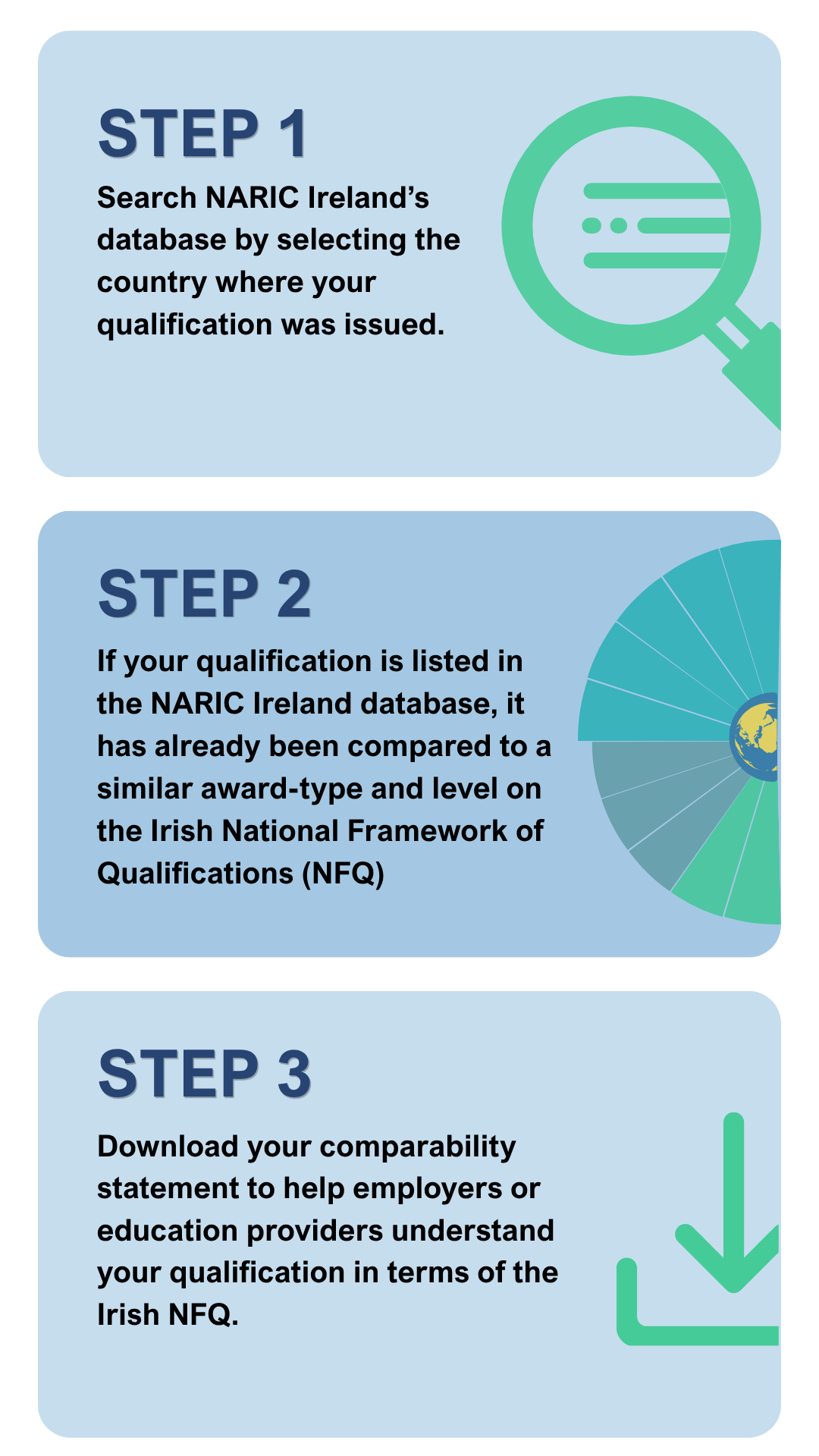
Step 1: Search by selecting the country where the qualification was issued.
Step 2: A published comparability statement explains how the qualification relates to the National Framework of Qualifications (NFQ).
Step 3: Download the comparability statement for NFQ level comparison and additional information on the award type.
NARIC Ireland is a member of ENIC-NARIC, the European Network of Information Centres-National Academic Recognition Information Centres. This network offers advice on the recognition of qualifications across Europe by providing information on education, training, and qualifications systems within individual countries. It uses the Lisbon Recognition Convention to ensure qualifications obtained in one country are recognised in all the others.
If you would like to have your Irish qualification recognised abroad, we recommend the following resources:
- For higher education and training qualifications - ENIC-NARIC.
- For further education and training qualifications - refer to the National Reference Point for the country in question.
NARIC Ireland aims to present data on the usage of its recognition service from around the world to help QQI meet its strategic objectives and to help identify trends and areas needing improvement and better communication.
NARIC Ireland 2023 - 2025 statistics on the recognition of foreign qualifications
People with refugee status or who have subsidiary protection, have the right to seek and enter employment, to carry on business, trade or professions, and to access education and training as a citizen.
NARIC Ireland services support the fair recognition of qualifications from home in line with the Lisbon Recognition Convention
Our supplementary ‘Rough guides’ further support the work of recruiters, guidance personnel, information officers, employers, education and training providers, schools, Institutions, competent authorities, and credential evaluators who meet with refugees and their families.
The Rough Guides put our current information on qualifications and the education and training system from each country together into a single document to support recognition decisions. Recognition decisions are not made by NARIC Ireland.
Our learning is gratefully drawn from many authoritative sources that are part of the recognition policy, ENIC-NARIC and Credential Evaluator community globally.
Credential Evaluators nationally will find the ENIC NARIC Manual helpful.
Please contact us if you would like to learn more about the European Qualifications Passport for Refugees (EQPR) developed by the Council of Europe. QQI is a recent signatory of this important initiative with support from colleagues in Technological University of the Shannon, Maynooth University, Munster Technological University, Dublin and Dun Laoghaire ETB, Limerick and Clare ETB, Cavan and Monaghan ETB Further Education Support Service.
NARIC Ireland is involved in national and international projects aimed at developing and promoting best practice in the recognition of foreign qualifications.
Through Erasmus+, we participate in the following projects with partners from other ENIC-NARIC centres:
- IAR 2030 led by NUFFIC, strengthens understanding and implementation of Automatic Recognition (AR) of higher education and upper secondary education and training qualifications and the outcomes of learning periods abroad because we will better connect networks of practitioners including within Institutions. Collaborative application of specific evaluative and information tools, including the European Higher Education Area (EHEA) qualifications table, will help make implementation of AR easier. Project partners shared goal is to share knowledge about smooth, efficient, sustainable and high-quality recognition in the European Education Area (EEA). The European Recognition Manual will be translated in other languages. Good practices for recognition information centres supporting the implementation of the UNESCO Global Convention and regional conventions (i.e. LRC) will be published. The project will also explore the possibilities for information sharing. (See also Automatic Recognition in the European Education Area 2030 (AR30) | Nuffic and Automatic Recognition in 2025 | Nuffic)
- Fraud-Act - Combatting Fraud through a Holistic Approach and Data Collection- led by CIMEA, addresses the global phenomena of educational fraud as it impacts fair recognition. The growth in the creation of fraudulent documents and the provision of higher education services by unaccredited institutions is better addressed with structured data. Our project focuses on interventions to support quality and integrity in recognition linked to prevention and the monitoring of educational fraud holistically based on strong international cooperation and innovation. (See also Council of Europe and CIMEA Join Forces to Launch New Centre Tackling Education Fraud - Council of Europe Platform on Ethics, Transparency and Integrity in Education)
- Verif-AI, ‘supporting the verification of authenticity through AI recognition’, led by CIMEA, focuses on verifying the authenticity of credentials, exploring how AI can help improve the quality of our practices. A White Paper will be developed, providing recommendations and guidelines targeting international regulatory frameworks, equity and ethical implications, the assessment of qualifications, and the verification of authenticity. NARIC Ireland does not verify authenticity of qualifications and credentials, but Irish Institutions and professional regulatory bodies do, and will benefit from the structured online tool that will also be developed as part of this project. In partnership nationally and internationally, this project will foster automatic recognition, and the transparent and fair recognition of third country nationals. (See also Artificial_Intelligence_and_Recognition_of_Qualifications.pdf)
Erasmus+ recognition projects which closed in 2025 include:
- ARAQUA: Road to Automatic Recognition of Higher Education Access Qualifications project led by the Latvian ENIC-NARIC, developed a comparative study report detailing progression and recognition arrangements to higher education in partner countries, and led to helpful Recommendations underpinning clarity for anyone who would like to confidently apply to study in other European countries on the basis of a school leaving or VET qualification. The NARIC Ireland News Brief, explains the ARAQUA project and automatic mutual recognition. For more information on this project and project partners click here.
- OCTRA 2: Online course catalogues and databases for transparency and recognition 2 explored information provision on Bologna cycle study programmes, with a particular focus on micro credentials, to support credential evaluation and recognition. Attention was paid to European Standards and Guidelines (ESG) of the Lisbon Recognition Convention (LRC) and accelerating and evolving practices. A systematic study of course catalogues and micro-credentials was carried out, informing the development of guidelines on the information provision on study programmes, courses and micro-credentials. NARIC Ireland participation was kindly supported by representative bodies, THEA and the IUA, and individual higher education institutions nationally. For more information on this project and project partners click here.
- MARTe – A technological approach to micro-credentials aimed to support and promote the European Education Area objectives and the application of the automatic recognition. The project explored the possible applications of automatic recognition to micro-credentials, by applying the text mining technology to learning outcomes across a wide range of micro-credentials. Examination revealed a strong need for greater focus on structured learning outcomes in micro-credentials to better enable recognition. A pilot stage tested the development, the release and the recognition of a micro-credential provided by a non-traditional institution. A detailed overview of the project results is provided in the final project publication, which describes the methodologies adopted and the lessons learned (full text available here).
- AR25 – Automatic Recognition in the EEA, 2025 promoted and implemented the Council Recommendation on promoting automatic mutual recognition of higher education and upper secondary education and training qualifications and the outcomes of learning periods abroad. AR25 supported the recognition of learning periods of upper secondary education through a mapping of national agreements on recognition, and the publication of a concise table of comparable qualifications in the Europea Higher Education Area using the EQF as a transparency tool. The work also consolidated skills between institutions in the field of micro-credential evaluation using the tool Micro-evaluator. The fourth edition of the European Area of Recognition Manual was published to guide and support credential evaluators in the Lisbon Recognition Convention Region. For more information AR25 (2023-2025) | Nuffic